FOR CLINICIANS
Verbatim voice dictation for Windows-based EMRs and clinical applications. $439 USD per year for the Medical plan. Free 30-day trial. Built and supported by a 28-year specialist in Australian healthcare voice technology.
No credit card. Reverts to the free tier (20 min/month) after the trial unless you upgrade.

A real dictation into Best Practice — from speak to text in under a second.

Speech Recognition Cloud is verbatim voice dictation software for Windows 10 and Windows 11. A clinician speaks into a microphone, the words appear at the cursor in whatever Windows application is open — an EMR, Microsoft Word, Outlook, Teams, a hospital intranet form, a clinical portal. It is built specifically for clinicians, with a continuously updated medical vocabulary covering drug names, anatomical terminology, eponyms, and procedural language.
The Medical plan is $439 USD per year. The free 30-day trial includes full Medical Ultra functionality. It is built and supported by an Australian company with 28 years of speech-technology deployment across Australian hospitals, GP practices, specialist clinics, and government health departments — with customers in the US, UK, Canada, New Zealand, and across Europe.
It works with every Windows-based EMR and practice management system because it dictates at the cursor at the operating-system level — not as a plugin or integration. That includes Best Practice, Medical Director, Genie, Zedmed, Communicare, and Helix in Australia; EMIS Web, SystmOne, Vision, and Adastra in the UK; Epic, Cerner (Oracle Health), Athenahealth, eClinicalWorks, NextGen, Allscripts (Veradigm), and Practice Fusion in the US; plus Microsoft Word, Outlook, Teams, OneNote, browser-based hospital portals, and any other Windows application you can click into and type into. There is no per-EMR certification, no plugin required, and no per-system setup.
The trade-off: the desktop application is Windows-only — there is no macOS or ChromeOS version. The companion mobile app for iPhone and Android partially mitigates this for Mac-based clinicians: it tunnels audio through remote-desktop connections so a Mac user can dictate normally into a Windows EMR session, and the Voice Notes mode lets a clinician on any phone deliver dictated text to a Windows PC anywhere in the practice. But the desktop application itself is Windows only.
$439 USD per year for the Medical plan, with a free 30-day trial of full Medical Ultra functionality. That includes unlimited dictation, the medical vocabulary, ultra-accuracy clinical mode, the companion mobile app, dedicated support, and one-on-one training. After the trial, the software reverts to the non-medical Free tier (20 minutes per month, general vocabulary) unless you upgrade. There is no automatic charge — your card is not held, nothing renews silently.
For a solo GP doing 25–30 notes-heavy consults a day, the cost typically recovers itself in time saved within the first month. For specialists doing fewer but longer consultations, or clinicians whose notes are mostly templated, the lower-tier Professional plan ($159 USD per year) with general vocabulary is often enough. The 30-day Medical trial is the honest answer to "which plan do I need" — try it on your real workflow and see.
For the full plan breakdown, see the pricing page.
Voice dictation suits four clinical workflows particularly well: progress and consult notes at the cursor inside any Windows-based EMR; discharge summaries, referrals, and clinical letters where prose is mixed with structured sections; ward rounds and bedside documentation using a smartphone as a wireless microphone; and the clinical correspondence inbox — pathology results, replies to GPs, internal team messages. Each one is covered below in detail.
The single highest-volume writing task in clinical work is the progress or consult note — the per-patient record that goes into the EMR after every consultation, ward visit, or telehealth appointment. For a busy GP working through a full appointment book, that is 25 to 35 notes per day. For a hospital registrar on a medical ward round, it can be more. The note is short, but the cumulative writing time is significant — and unlike the structured fields in an EMR, the prose section is where clinical reasoning actually gets documented.
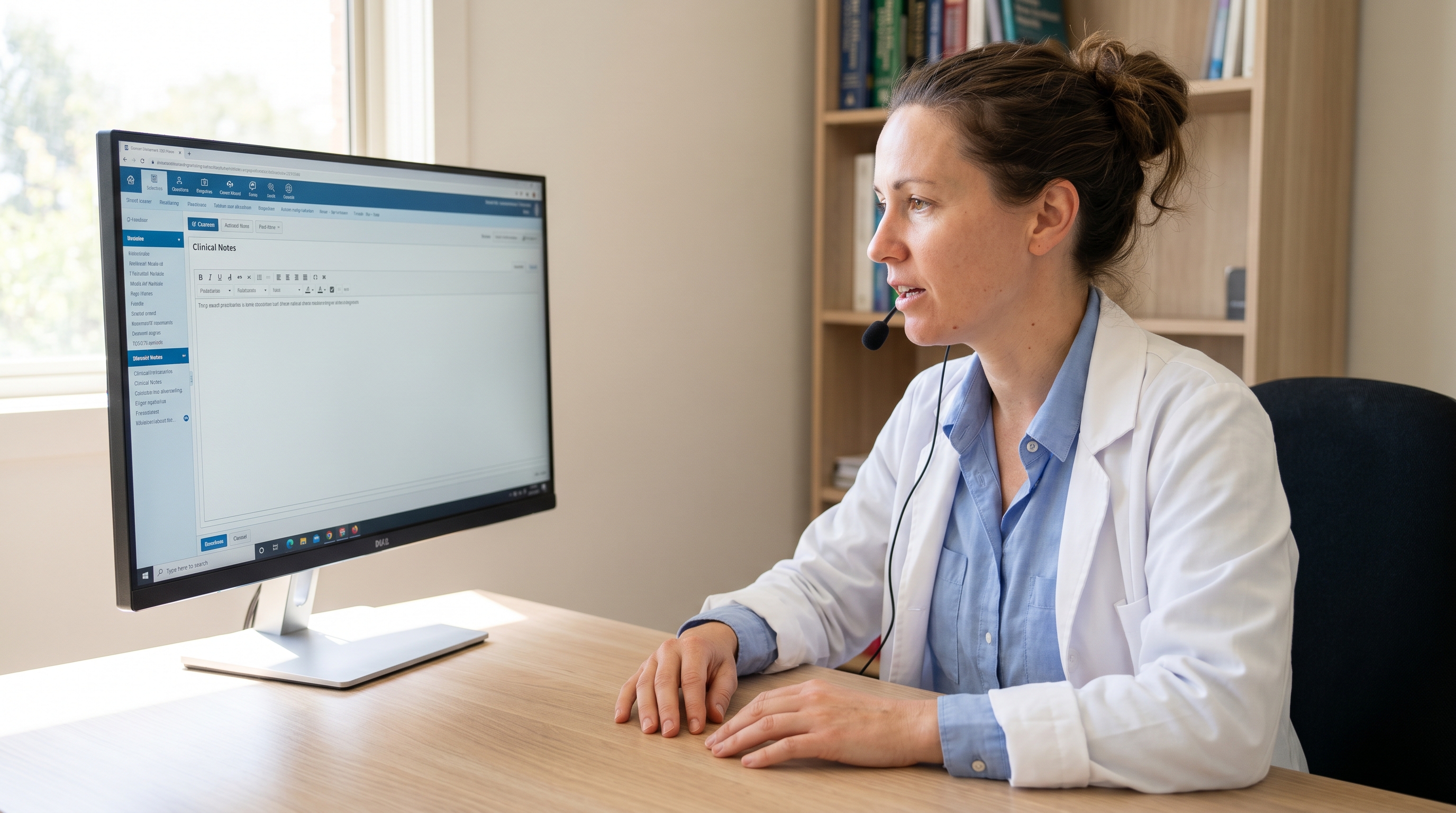
Dictation suits this work for one specific reason: it separates the thinking about a patient from the typing of the note. Most clinicians who shift this workflow to voice describe it as switching from "writing a note" to "talking through the patient" — and the resulting documentation tends to be more complete because spoken clinical reasoning is naturally more thorough than typed shorthand.
A practical workflow that scales:
The first day will feel awkward. By the end of the first half-day clinic, most clinicians describe the workflow as faster than typing. The compounding effect across a five-day clinical week is where the actual time recovery shows up — though we would encourage you to time your own first session before trusting any general claim about speed.
Discharge summaries and specialist referrals are the highest-stakes writing in clinical practice. They are read by the next clinician in the care chain, they sit permanently in the medical record, and they are scrutinised in audit, complaint, and medicolegal review. Most clinicians write them slowly because they are being careful — about tone, about what to include, about what the receiving clinician needs to act on.
Dictation fits this work in two ways. First, the structured sections of a discharge summary — admission summary, principal diagnosis, secondary diagnoses, procedures, complications, discharge medications, follow-up plan — reward consistency of phrasing across patients. Saved templates for each section let you keep the framing consistent while the patient-specific detail is dictated in. Most clinicians find this faster than typing, and the templates also serve as a quiet checklist that nothing important is being missed.
Second, the prose sections — the narrative summary, the reasoning behind the plan, the social and contextual notes — are usually easier to describe than to write. "The patient was admitted with a three-day history of progressive shortness of breath on a background of well-controlled COPD. Examination on admission demonstrated bibasal crackles and oxygen saturation of 88% on room air. Chest X-ray showed bilateral lower zone consolidation consistent with community-acquired pneumonia." That paragraph is faster to speak than to type for most clinicians, and the clinical detail tends to be more specific when dictated.
The same approach extends to specialist referrals (the reason for referral, the relevant history, the specific question being asked), discharge letters to GPs, medicolegal reports, and the longer clinical correspondence that does not fit easily into a structured EMR field. Where the standard opening and closing phrasing is required by your hospital, college, or insurer, save it as a template once and trigger it by voice thereafter.
Ward rounds are the workflow where most desktop dictation tools fall over and where Speech Recognition Cloud's mobile companion app earns its place. The clinical reality of a ward round is that the clinician is not at a workstation — they are at the bedside, moving between rooms, often without a free hand for a keyboard. Documentation either happens after the round (delayed, less accurate, often skipped) or it happens through whatever portable input the clinician can carry.
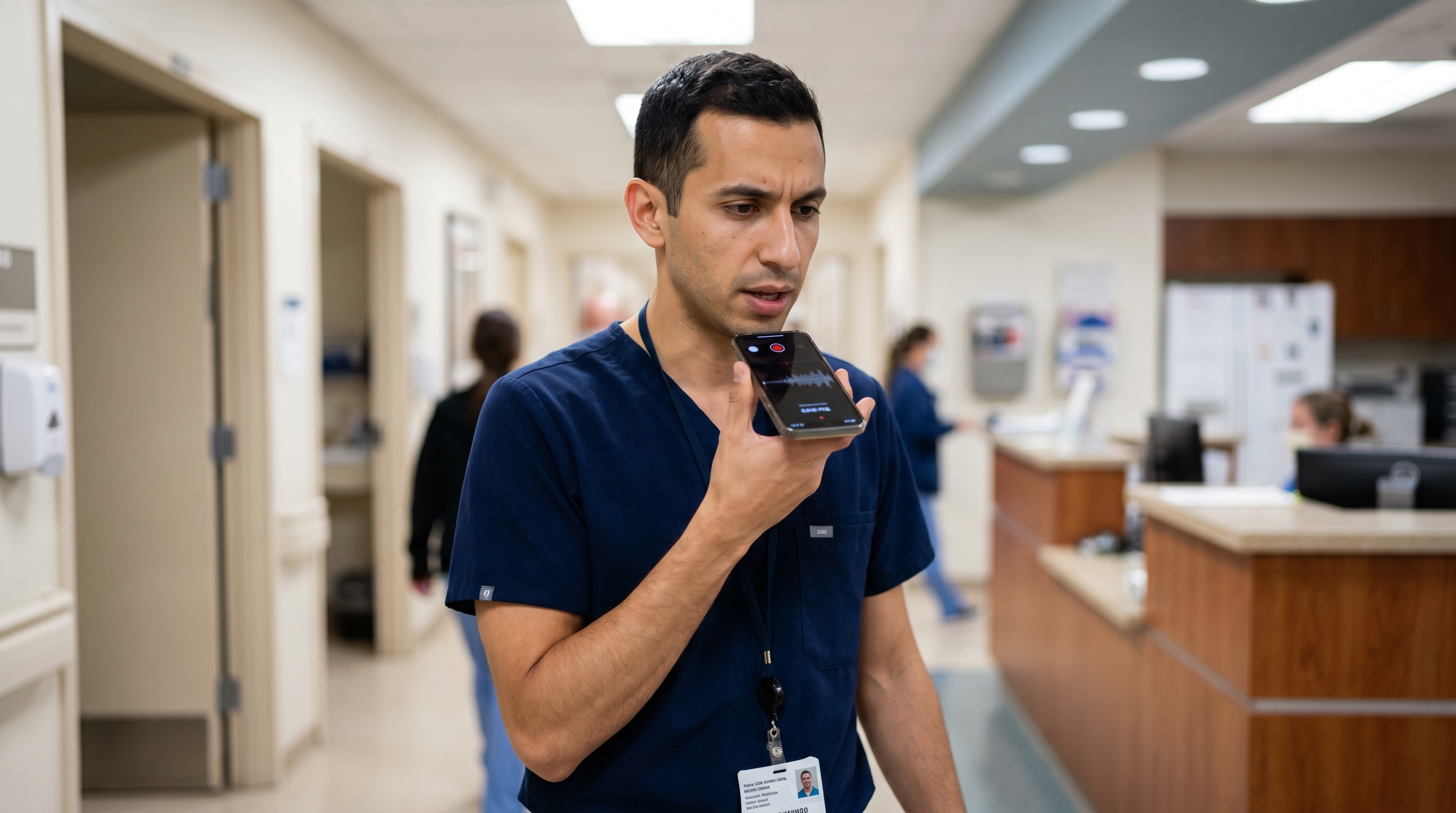
The companion mobile app for iPhone and Android handles this directly. The clinician uses their own phone — already in their pocket, already cleaned to their personal standard — as a wireless microphone or as a standalone recorder. Two practical modes:
The hygiene side is worth mentioning explicitly. Shared desktop microphones at nurses' stations and ward workstations have always been a hygiene compromise — they are touched by many clinicians across a shift, they are difficult to clean to a clinical standard, and they are a known surface for healthcare-associated infection transmission. A personal smartphone, used as the microphone, removes that problem entirely. It also removes the related problem of microphones disappearing from wards.
The inbox category — pathology and imaging results to be acknowledged and acted on, internal team correspondence, replies to GP queries, requests to and from allied health, prescription queries, administrative back-and-forth with hospital admin and insurers — is the writing most clinicians treat as overhead. It is also the writing that, in aggregate, eats the most non-consultation time.
Dictation handles this work well. Patterns that compound:
Clinical correspondence is also where the AI Modes exclusion on the Medical plan matters. The Medical tier deliberately does not include the AI Modes (Write, Rewrite, Answer, Reply, Run Command) that are available on the Professional plan. The reason is straightforward: AI Modes send the text you are working with to an external model for rewriting or answering, and in clinical correspondence that means sending patient-identifiable content into a generative AI flow. The Medical plan removes that data path entirely. What you dictate is what you get — verbatim, no AI generation step.
Speech recognition, AI scribes, and ambient clinical documentation tools are different categories of product. They are often discussed as if they were interchangeable, and the resulting confusion costs clinicians money on the wrong tool for their workflow. Worth being explicit about what Speech Recognition Cloud does not do.
No. Speech Recognition Cloud is verbatim cursor-based dictation, not ambient AI documentation. The clinician speaks, the words appear at the cursor, the clinician edits. There is no background listening during consultations, no AI-generated summary of what was said, and no automatic structuring of conversation into SOAP notes. If you want ambient documentation, an AI scribe is the right category of product — they are different tools for different workflows. If you want fast, accurate, predictable dictation with no AI generation step in the data path, that is what SRC does.
No. Meeting transcription tools join video calls, record audio, transcribe both speakers, and produce a searchable transcript. Audio file transcription services accept a recording and return a transcript by email some minutes or hours later. Speech Recognition Cloud is neither. It transcribes your live speech into the application you are currently working in. It does not record meetings, transcribe pre-recorded files, or transcribe what other people say.
No. Speech Recognition Cloud transcribes what the clinician says. It does not suggest differentials, flag drug interactions, prompt for missing history, or contribute clinical content beyond what the clinician dictates. The medical vocabulary helps the system transcribe clinical terminology accurately — it does not introduce clinical reasoning. This is intentional: clinical decision support and clinical documentation are separate concerns, and combining them in a single transcription path creates risk that is not justified by the productivity gain.
No. Speech Recognition Cloud is general-purpose dictation software with a medical vocabulary. It is not regulated as a medical device under the TGA (Australia), the FDA (United States), the MHRA (United Kingdom), or equivalent regulators elsewhere. It has not been clinically validated for diagnostic, therapeutic, or patient-management use. Clinicians use it as a documentation tool — the same way a clinician uses a word processor or a dictaphone — and the clinician retains full responsibility for the accuracy and clinical appropriateness of what enters the record. Reading dictated text back before saving it to the medical record is the clinician's responsibility, the same as reading a typed note before saving.
No — and it would be dishonest to suggest otherwise. Voice dictation is a productivity tool. The administrative burden on clinicians is structural: it comes from accreditation frameworks, MBS and audit requirements, indemnity and medicolegal documentation expectations, hospital reporting obligations, and EMR systems that prioritise data capture over clinician workflow. The relief dictation offers is real but bounded — it changes how fast you can produce a given paragraph of clinical prose, not how many fields and forms the system requires you to fill. For some clinicians that is enough to claw back an hour or two a week, which compounds across a clinical year. For others — particularly clinicians whose admin time is dominated by structured-field data entry rather than prose — the gains are smaller. Try it for a fortnight on the workflows that actually involve writing, and form a view based on your own experience rather than on a vendor's claim.
Three questions worth asking your practice manager or hospital IT lead before installing any cloud-based speech recognition on a clinical device: what data leaves the workstation and where does it go, does your organisation's IT policy permit cloud dictation on clinical computers, and are there content categories you should not dictate in shared clinical spaces?
The data-protection and clinical-record frameworks that govern dictation vary by jurisdiction. The three most relevant for our visitors are covered below.
REGIONAL CONTEXT — AUSTRALIA
Yes. AHPRA's professional standards and the codes of conduct published by the National Boards expect clinical records to be contemporaneous, accurate, complete, and legible. Voice dictation supports all four directly: the note is produced at or near the time of the consultation rather than retrospectively, the dictating clinician is the named author with no intermediary, the prose form encourages more complete reasoning than typed shorthand, and the typed output is by definition legible. The clinician's responsibility — reading the note back before saving — is the same as for typed notes.
Australian EMRs. The cursor-based approach works inside Best Practice, Medical Director, Genie, Zedmed, Communicare, Helix, and the other major Australian clinical systems. Progress notes, consult notes, recall notes, referrals, prescription notes, and any other free-text field in the patient record — anywhere the system presents a text input, SRC dictates at the cursor. There is no per-system certification, plugin, or configuration required.
Australian Privacy Principles and the Notifiable Data Breaches scheme. Health information is treated as sensitive information under the Privacy Act 1988 and the APPs, with stricter handling expectations than general personal information. Speech Recognition Cloud's relevant data handling: audio is processed in memory and immediately erased, transcripts are not retained on our servers, our staff cannot access either, and the privacy statement documents the data flow in detail. Practices subject to the Notifiable Data Breaches scheme should review the privacy statement against their own breach-response plan.
Telehealth and the MBS. SRC handles the documentation side of telehealth consultations — the clinician dictates the consult note during or immediately after the call, the same as for face-to-face. The software does not transcribe the patient's speech and does not record the consultation. Documentation requirements for MBS-billable telehealth items are the same as for in-person consultations; dictation just changes how the note gets written, not what the note has to contain.
NDIS, allied health, and Medicare Mental Health Care Plans. The free-text sections of allied health reports, mental health care plan reviews, NDIS progress reports, and the longer narrative components of these documents are well-suited to dictation. The structured fields and tick-box sections are not — those still need clicks. The cost-benefit usually favours dictation for clinicians whose reports are more prose than form.
For broader voice-technology procurement in Australian healthcare — including hospital deployments, Dragon Medical One licensing for clinicians who specifically need that product, NDIS-funded clinician deployments, and on-site training — our parent business operates a dedicated medical and healthcare collection at Voice Recognition Australia, which has been supplying Australian healthcare for over 25 years.
REGIONAL CONTEXT — UNITED STATES
HIPAA compliance is a property of a deployment, not a software product — it depends on how the tool is used and what agreements are in place between the covered entity and any service providers. Speech Recognition Cloud's underlying data handling supports HIPAA-compliant deployment: audio is processed in memory only and immediately erased, transcripts are never stored on our servers, our staff cannot access audio or transcripts, all connections are encrypted in transit, and AI Modes are excluded from the Medical tier by design. US clinicians and practice administrators should review our privacy statement against their own Security Risk Analysis before deploying.
US EMRs. The cursor-based approach works inside Epic, Cerner (Oracle Health), Athenahealth, eClinicalWorks, NextGen, Allscripts (Veradigm), Practice Fusion, and the other major US clinical systems. The same caveats apply: no per-EMR certification, no plugin, no per-system configuration. SRC dictates at the cursor in the Windows desktop application, the browser-based portal, or wherever your clinical workflow puts text input.
Telehealth and remote work. US clinicians working from home, between clinics, or across multiple sites can use SRC the same way at each location — the cloud-based vocabulary, templates, and preferences follow the clinician rather than the workstation. The companion mobile app is particularly relevant for clinicians whose home workstation is a Mac remoting into a Windows EMR at the practice.
Independent practice and the cost question. For US clinicians in solo or small-group practice, the cost difference between SRC ($439 USD per year) and the established legacy clinical dictation products is significant. The 30-day Medical Ultra trial lets independent practitioners evaluate the workflow on real consultations before committing.
REGIONAL CONTEXT — UNITED KINGDOM AND EUROPE
Speech Recognition Cloud is general-purpose dictation software, not a clinical safety system under DCB0129. Individual NHS clinicians can use it for personal documentation workflows on permitted devices, but any deployment beyond individual use should go through the trust's IG and clinical-safety functions. Under UK GDPR, health data is special category data — Speech Recognition Cloud's data flows (audio processed in memory and erased, transcripts not retained, all connections encrypted) support compliant deployment subject to the clinician's organisation completing a Data Protection Impact Assessment.
UK clinical systems. The cursor-based approach works inside EMIS Web, SystmOne (TPP), Vision, and Adastra in primary care; inside the major NHS hospital electronic patient record systems where Windows-based clinical workstations are used; and inside the standard Microsoft 365 surfaces (Word, Outlook, Teams) that NHS clinicians use for clinical correspondence. The same caveats apply: no per-system certification, no plugin, no per-system configuration.
NHS Digital, DCB0129/DCB0160, and DTAC. NHS deployment of any clinical software typically involves the Digital Technology Assessment Criteria and, where relevant, the clinical risk management standards DCB0129 (manufacturer responsibility) and DCB0160 (deploying organisation responsibility). Clinicians considering deployment on NHS-managed devices should consult their trust's IG and clinical-safety functions before installation — particularly for any deployment beyond individual clinician use.
EU GDPR. The data-flow position is the same across the EU under GDPR — health data is special category data under Article 9, the lawful basis for processing is provided through the clinician's relationship with the patient, and the data-handling questions for cloud dictation are the same as in the UK. EU-based clinicians should confirm with their national data-protection authority and their practice's data-protection officer whether SRC's data flows align with their organisation's processing register.
Languages and the EU. The non-medical Speech Recognition Cloud tiers support 57 languages, which makes it useful for the broader administrative and correspondence work of European clinicians working in their native language. The Medical tier is currently English-only — the specialised medical vocabulary is only available in English at present.
Four steps, about ten minutes from install to first note: install the software (30-day Medical Ultra trial is free), set up a microphone (a USB headset or your smartphone via the companion app), open your EMR and click into the notes field, then dictate the consultation in plain clinical language. Punctuation is automatic. The detailed walkthrough is below.
Install Speech Recognition Cloud (the 30-day Medical Ultra trial is free). Plug in a USB headset if you have one, or set up the companion mobile app on your phone — the app turns your iPhone or Android into a wireless microphone, which is the cleanest option in clinical environments. Allow microphone access when Windows prompts. No voice training, no enrolment, no calibration.
Open the patient record in Best Practice, Medical Director, Genie, Zedmed, Epic, Cerner, or whichever Windows-based EMR you use. Click into the progress-notes or consult-notes field for the patient. SRC dictates directly at the cursor in any Windows application — there is no separate dictation window to wrestle with, no copy-paste step, and no fallback to a holding box if the EMR's text editor is non-standard.
Start dictation. Describe the consultation in plain clinical language — for example: 'Mrs Smith presents today with a two-week history of right lower quadrant pain, intermittent, worse after meals. Examination unremarkable except mild tenderness on deep palpation. Bloods unremarkable. Plan ultrasound and review in one week.' Speak naturally. Punctuation is handled automatically — you do not need to say 'full stop' or 'comma.' Drug names and clinical terminology are transcribed from the medical vocabulary.
Read the note. Edit by voice or keyboard for any patient-specific terms the system did not catch — add them to your personal vocabulary as you go so they transcribe correctly thereafter. Move to the next patient. Most clinicians describe the first few consults as awkward and the workflow becoming natural within a single half-day clinic.
If after a full clinic session it still feels slower than typing, dictation may not suit your style — and that is a useful thing to discover after one trial rather than three months in. For more setup help, see the getting-started walkthrough.
Five tips that compound across a clinical year: build a personal vocabulary on day one, save your standard clinical phrases as templates, draft first and polish later, use the mobile app as a wireless microphone in shared clinical spaces, and read every note back before saving. The last one is the discipline that separates clinicians who use dictation well from clinicians who get into trouble with it.
Patient surnames that do not transcribe correctly on first pass, your colleagues' names, local hospital ward names, any specialty-specific abbreviations your team uses, and the small handful of drug names the medical vocabulary does not catch first time — add them to your personal vocabulary as you go. Five minutes of vocabulary-building in your first session saves hours of corrections across the clinical year.
The standard opening for a new-patient consult, the wording you use for medication reviews, the formula for a routine post-operative follow-up, the boilerplate around a referral — save each as a named template you can insert with a short voice command. The personalised middle of each note is what you dictate; the standard scaffolding is one command. Templates and text replacements are available on the Professional and Medical plans.
Do not try to dictate a perfect first sentence. Dictate the rough version of the whole note, then read it back and tighten the bits that need tightening. Trying to speak polished prose in real time slows almost everyone down — and clinical notes do not need to be polished prose. They need to be accurate, complete, and timely.
A USB headset is fine in a private consulting room. In a shared clinical space — a ward, a nurses' station, an open-plan registrar room — the companion mobile app on your own phone is usually better. It eliminates the hygiene issues of shared desktop microphones, keeps your dictation private from colleagues nearby, and means your microphone is always with you rather than tethered to a workstation.
This is the discipline that separates clinicians who use dictation well from clinicians who get into trouble with it. Read the note back on screen before saving it to the medical record — the same way you would read a typed note before saving. The reading-back step is fast (seconds, not minutes) and it catches the small transcription errors that can carry clinical weight: "no" transcribed as "now," a patient name that swapped with the previous patient's, a drug name that came through as a similar-sounding term. The system is accurate; the clinician is responsible.

Every feature designed around how clinicians actually work — in hospitals, clinics, and on the move.
The Medical plan includes a companion app for iPhone and Android that turns your smartphone into a wireless microphone for SRC on your PC. In hospital environments this eliminates shared desktop microphones entirely — no hygiene concerns, no theft, no cleaning protocols. The app also tunnels audio through remote desktop connections, so a clinician on a Mac remoting into a Windows EMR machine can dictate normally without additional hardware.
When you are doing ward rounds or working in areas without reliable internet, the mobile app records your dictation offline on your iPhone or Android. When connectivity resumes, completed documents are delivered to whichever PC is logged into SRC — ready to paste directly into your EMR. No audio is lost and no internet connection is required at the point of dictation.
Speech Recognition Cloud works directly at the cursor in every Windows application — Best Practice, Medical Director, Genie, Zedmed, Epic, Cerner, Outlook, Word. There is no separate dictation window, no copy-paste step, and no fallback to a holding box if the application's text editor is non-standard. Text appears exactly where your cursor is, and you can switch between applications instantly without reconfiguring anything.
You do not need to say "full stop," "comma," or "new line." SRC handles punctuation automatically based on the natural rhythm and structure of your speech. This is a meaningful workflow improvement over dictation products that require spoken punctuation commands — clinical dictation flows more naturally when you can speak the note rather than narrate the punctuation.
The medical vocabulary is maintained and updated continuously in the cloud. New drug names, clinical terminology, and procedural terms are added without you needing to install updates or purchase new versions. This is a meaningful advantage over legacy dictation products where vocabulary improvements are tied to paid version upgrades. You can also add your own custom terms, abbreviations, and organisation-specific language through the built-in vocabulary editor.
Save acronyms, organisation names, or complete boilerplate text sections that expand on voice command. If you regularly dictate the same referral framing, discharge sections, or standard clinical phrases, you can trigger them with a short spoken keyword instead of dictating them from scratch every time. Available on the Professional and Medical plans.
Enhanced accuracy processing tuned for clinical terminology. No voice training, no calibration, no setup wizards — install and start dictating immediately. The system improves as the cloud medical vocabulary is updated.
Speech Recognition Cloud Medical is $439 USD per year. That is roughly a third of the cost of established legacy clinical dictation products. There are no upgrade fees, no serial numbers, no version compatibility headaches, and no per-seat infrastructure costs. The cloud-based model means you always have the latest version without paying for major upgrades.
Mark S.
Adelaide
"Thank you very much for providing me with the free access. I am using it right now to create this email."
Carrie H.
Wollongong
"I've only been using it for a few minutes, but it is extremely accurate and quite easy to use."

J.H.L
Perth
"Automatic punctuation without having to say comma or full stop is brilliant!"

T.M
Brisbane
"I've been using it for 5 minutes and it's already better than any old dictation product. And free? Thanks!"
Audio is processed in the cloud and immediately erased. No recordings saved. No data used for training. All connections encrypted. AI Modes excluded from the Medical tier by design.
Read our privacy policy →Almost certainly, yes. Speech Recognition Cloud dictates at the cursor in any Windows application — that includes Australian systems like Best Practice, Medical Director, Genie, Zedmed, and Communicare; UK systems like EMIS, SystmOne, and Vision; US systems like Epic, Cerner, Athenahealth, and eClinicalWorks; and any other Windows-based EMR you can click into and type into. It does not integrate with the platforms specifically — it operates at the operating-system level — which is why it works across all of them without per-platform setup or certification.
No. Speech Recognition Cloud is verbatim cursor-based dictation. What you say is what appears on screen. It does not listen to consultations in the background, it does not summarise what was said, and it does not rewrite your words into structured notes. The clinician dictates, the text appears, the clinician edits. There is no AI generation step, which means no risk of hallucinated content in a clinical record.
Both are clinical dictation tools. The practical differences clinicians most often raise are: SRC dictates directly at the cursor in every Windows application without falling back to a separate dictation box; SRC handles punctuation automatically rather than requiring spoken punctuation commands; the medical vocabulary is maintained continuously in the cloud rather than tied to version upgrades; the companion mobile app turns an iPhone or Android into a wireless microphone, which is useful in hospital settings where shared microphones raise hygiene concerns; and the annual price is roughly one third of equivalent legacy products. The comparison that matters for any individual clinician is whichever tool fits the workflows they actually use — we would encourage a 30-day trial rather than a switch based on feature lists.
HIPAA compliance is a property of a deployment, not a software product — it depends on how the tool is used, what data flows occur, and what agreements are in place between the covered entity and any service providers. What we can tell you about Speech Recognition Cloud Medical is the underlying data handling: audio is processed in memory only and immediately erased after transcription, transcripts are delivered to the cursor on your own computer and never stored on our servers, our staff cannot access audio or transcripts, and AI Modes are excluded by design from the Medical tier to keep the data path as narrow as possible. US clinicians and practice administrators should review our privacy statement against their own HIPAA Security Risk Analysis before deploying.
Yes, for the documentation side of telehealth. You speak, the text appears in your EMR or video-platform notes field. Speech Recognition Cloud is not a video platform itself and does not transcribe the patient's speech during a telehealth call — it transcribes what you, the clinician, dictate into your own microphone. Most clinicians using SRC for telehealth dictate consult notes either during the call (microphone on, patient muted briefly) or immediately after, while the consultation is fresh.
No. We only store your email address for product updates and authorisation. Audio is processed in memory and immediately erased — never written to disk, never retained, never accessible to our staff. Transcribed text is delivered to the cursor on your own computer; we do not retain a copy. Custom vocabulary you add stays on your own device. We do not store voice profiles, dictation history, or any clinical content.
The Speech Recognition Cloud desktop application is Windows 10 and Windows 11 only — Mac support is on our roadmap but has no current ETA. Two practical workarounds for Mac-based clinicians: the companion mobile app for iPhone and Android tunnels audio through remote-desktop connections, so a clinician on a Mac remoting into a Windows EMR machine can dictate normally; and the mobile app's Voice Notes mode lets a clinician dictate documents on their phone and have the text delivered to the practice's Windows PC, which is useful where a single shared Windows machine sits alongside several Mac workstations.
Yes. Each user logs into Speech Recognition Cloud with their own account, which means custom vocabulary, templates, and preferences follow the clinician rather than the workstation. On a shared computer, the next clinician logs in and gets their own configuration. The companion mobile app is also relevant here — using a personal smartphone as a wireless microphone eliminates the hygiene and cleaning issues that come with shared desktop microphones in clinical environments.
In a private consulting room, the laptop or workstation's built-in microphone is usually adequate, though a USB headset gives noticeably cleaner results. In a shared clinical space — a ward, a nurses' station, an open-plan registrar room — a directional USB headset or the companion mobile app on your own phone is the practical default. Both reduce background-noise pickup and keep your dictation private from colleagues and patients nearby.
The medical vocabulary covers the standard pharmacopoeia, anatomical terminology, common eponyms, and procedural language across general practice and the major specialties. The cloud-updated model means new drug names and clinical terms are added continuously rather than waiting for a paid upgrade. For specialty-specific abbreviations or organisation-specific terms — local hospital ward names, custom referral pathways, idiosyncratic acronyms your team uses — you can add them to your personal vocabulary through the built-in editor.
Medical Ultra is free for 30 days with full functionality. After that the software reverts to the non-medical Free tier (20 minutes of dictation per month, general vocabulary, no medical mode) unless you upgrade to a paid plan. There is no automatic charge — your card is not held, nothing renews silently. You either choose to upgrade or the software remains on the free tier.
It depends on how much you dictate. The Medical plan is $439 USD per year for unlimited dictation with the medical vocabulary, ultra-accuracy mode, dedicated support, and one-on-one training. A solo GP doing 25–30 consults a day with a notes-heavy workflow typically finds the cost recovers itself in time saved within the first month. A specialist doing fewer but longer consultations, or a clinician who writes most notes from templates anyway, may find the Professional plan ($159 USD per year) with general vocabulary is enough. The 30-day Medical trial is the honest answer — try it on your real workflow and see what you actually need.
For more setup answers, see the support FAQ.
No credit card. No voice training. Install in 2 minutes. Reverts to the free tier after 30 days unless you upgrade.
